
1.1 The ENIAC
The concept of a data center first took form in the mid-1940’s with the development of the Electronic Numerical Integrator and Computer, or ENIAC, at the University of Pennsylvania [1]. Originally created to aid the U.S. Army by automating ballistics calculations, the 1,800 SFT facility was filled with nearly 18,000 vacuum tubes for data processing, over 6,000 switches and miles of wiring, and custom cooling systems [2]. As time progressed, the ENIAC was also used for scientific modeling, nuclear energy, weather research, and data processing [1], [3]. As one of the first machines capable of performing 5,000 additions per second, it marked a significant advancement in the world of computing [3]. Though much different in appearance and technology from the data centers of today, the ENIAC marked the first step towards the high-powered facilities of modern times. The ENIAC’s design principles of modularity and redundancy became core tenets of modern data center infrastructure [4], and the leaders of the ENIAC program, John W. Mauchly and J. Presper Eckert, went on to create the first commercially available computer, the UNIVAC I [5].
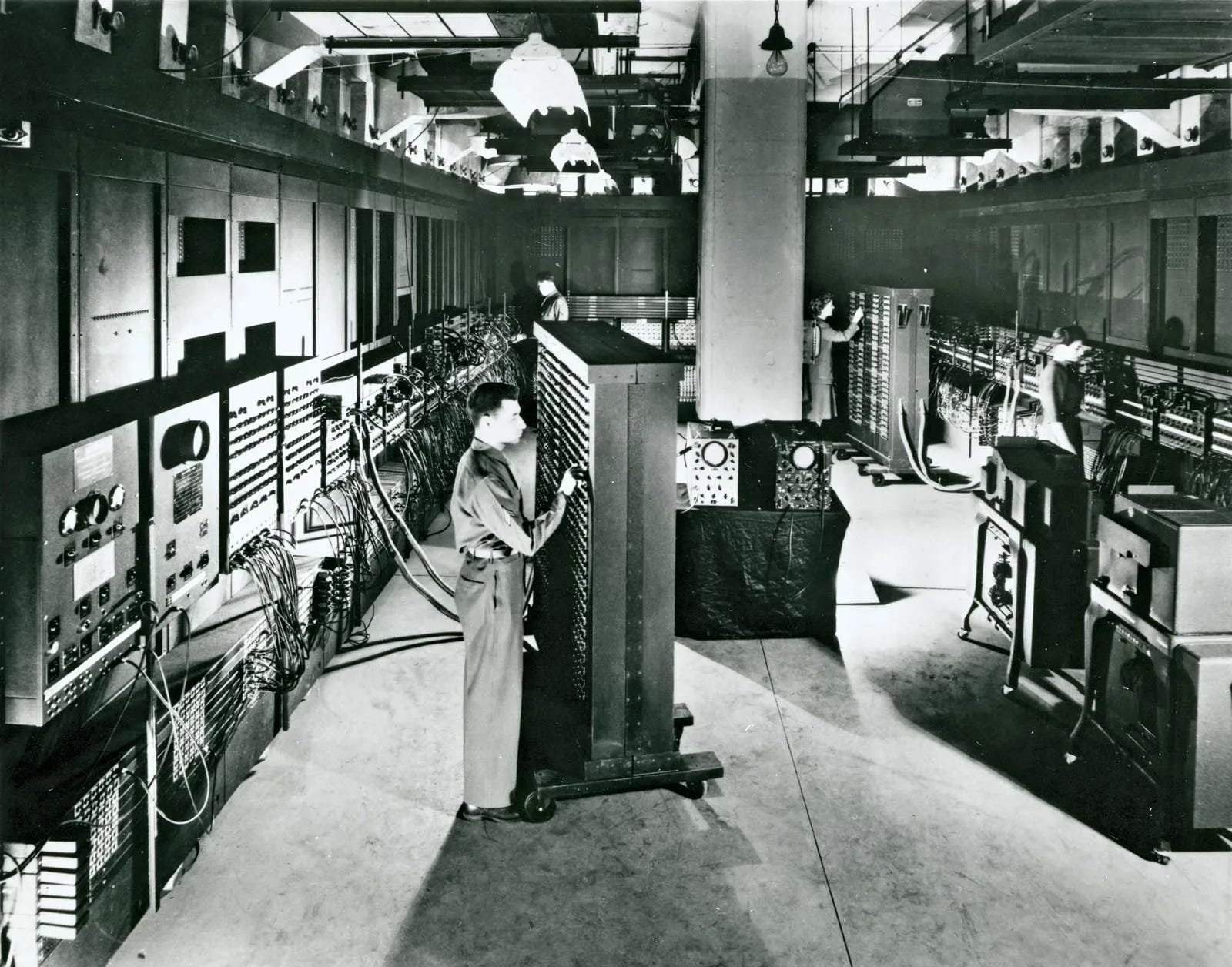
The ENIAC, 1946 (Courtesy of Britannica)
1.2 The SAGE
Around a decade after the advent of the ENIAC, a more advanced interpretation emerged with the Semi-Automatic Ground Environment, or SAGE, system. The SAGE was developed for the U.S. Air Force with collaboration between MIT and IBM, bringing the first operational site live at McGuire Air Force Base in New Jersey [6]. The number of SAGE installations eventually grew to over twenty locations across the U.S. and Canada, with the bunker-style buildings providing real-time defense tracking against potential Soviet nuclear bomber threats [7].
Notable technological advancements were employed at these facilities, like:
• IBM AN/FSQ-7 Computers – The largest and most powerful computer ever built, weighing 250 tons with 60,000 vacuum tubes [8].
• Expansive Mainframes – A single SAGE computer could process 75,000 instructions per second [9].
• CRT Display Consoles – Used by military personnel to visualize radar and flight tracking in real time [10].
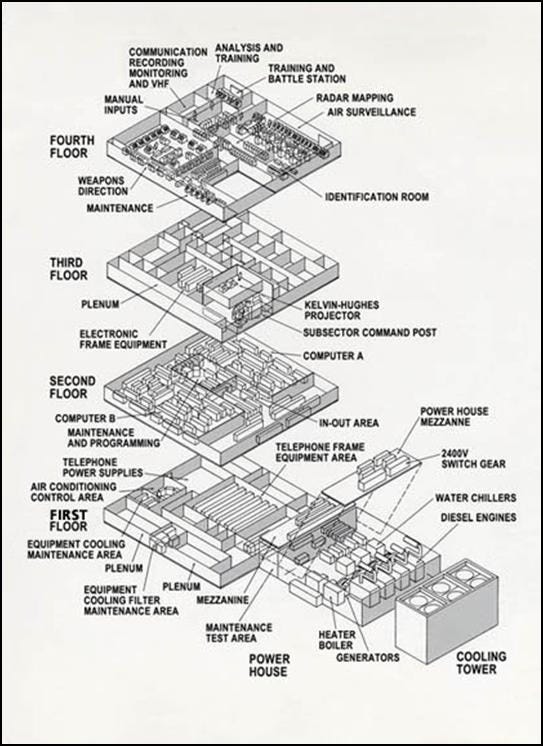
SAGE Schematic (Courtesy of MITRE Corp.)
More notable is the fact that SAGE was the first large-scale computer network, as it linked dozens of sites in real-time using dedicated telephone lines and served as a precursor to ARPANET and modern internet [11]. At an expense of $8B at the time, or $70B+ today, the SAGE directly influenced the development of networked computing, real-time data processing, and cybersecurity [12].
1.3 The Evolution of Data Centers
The evolution of data center design is correlated directly with both increasingly technical user requirements and continued innovation of networking, power and cooling systems. From the early days of the ENIAC and SAGE installations to modern hyperscale facilities with footprints of hundreds of thousands of square feet and consumption of hundreds of megawatts of power, user demands for greater computing and storage facilities and breakthroughs in design and engineering have allowed data centers to scale to unprecedented heights. The following section will provide an overview of this evolution to better illustrate these innovations.
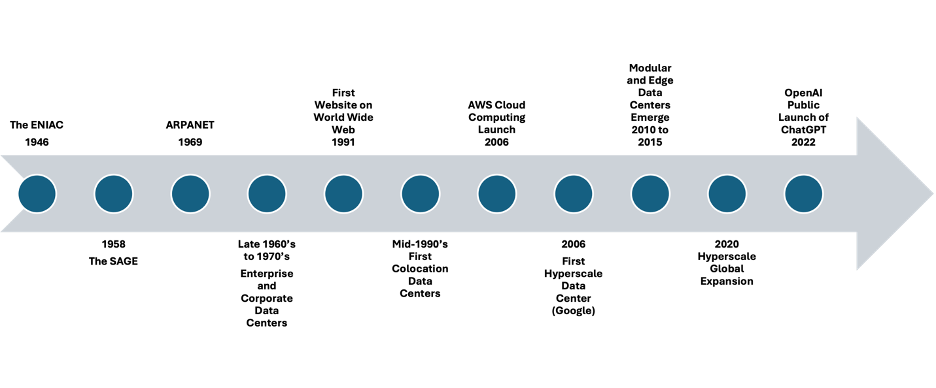
1.3.1 The Birth of Data Centers (1940s–1950s)
As you read, the earliest data centers were large, centralized computing rooms that housed mainframes and were primarily developed for military and national defense uses. With governments and universities as the primary operators, characteristics of this era’s infrastructure included large mainframe rooms with specialized cooling and punch cards and magnetic tape for data storage [13].
1.3.2 The Rise of Corporate Data Centers (1960s–1980s)
By the 1960’s, mainframes saw broader adoption in the corporate sector driven by innovations by companies like IBM with their 360 System, the first general purpose mainframe [14]. The ARPANET in 1969 also helped drive mainframe adoption, serving as an early internet precursor that linked computing sites [15]. In the 1970’s, the DEC PDP series introduced minicomputers, which were smaller and more affordable than the existing mainframes [16]. As companies sought to build dedicated computer rooms and data centers, infrastructure innovations like Ethernet and raised floors, which enabled better cooling and cable management, began to influence the design theory of data centers at larger scale [17]. Though the initial corporate players were banks, airlines and telecom companies, the ensuing mainstream adoption of the internet would open the data center market to a wider range of users and applications.
1.3.3 The Internet Boom and Commercial Data Centers (1990s–2000s)
With the dot-com boom, roughly 1995-2001, bringing overwhelming demand for web hosting and internet services, colocation providers emerged with a new offering. The colocation business model allowed for companies to rent rack space instead of building their own facilities and offered greater flexibility not previously available [18]. Innovations in fiber optic cabling and internet service providers (ISP’s) enabled internet growth, along with Cisco and Juniper introducing high-performance networking gear that helped client-server architecture replace mainframes in many businesses. A major move came in 2006 when Amazon Web Services (AWS) launched cloud computing, making colocation computing more accessible than ever before [19]. With the rise of colocation, the new data center operators had to focus on redundancy and efficiency of their facilities as their client contracts hinged on reliability and availability.
1.3.4 Hyperscale and Cloud Revolution (2010s–Present)
Over the last fifteen years, we have witnessed the rise of massive cloud, or hyperscale, data centers developed by tech giants like Amazon, Google, Microsoft and Meta. Other notable companies like Apple and Oracle have not been too far behind as all of these players have sought larger amounts of power (electricity) and space (land) to build large footprint facilities to house their computing infrastructure. As of early 2024, the number of hyperscale data centers globally surpassed 1,000, with the United States hosting approximately half of them [20]. As of late, artificial intelligence (AI) and machine learning (ML) have pushed the industry to a height never seen before [21]. Hyperscale infrastructure innovations continue to evolve across power distribution and cooling systems and equipment, facility layouts, and network topology and architecture- not to mention the rapid innovation of silicon chips that power the servers of today. These facilities now consume hundreds of acres and gigawatts of power with buildings over a million square feet and growing. The real-time monitoring and control of the physical and digital infrastructure driving this compute craze has also advanced significantly, allowing operators to analyze their data centers down to the watt and focus on extreme efficiency. Looking to the future, fields like quantum computing and AI will continue to drive innovation in all aspects of data centers [22].
References
[1] T. Haigh, M. Priestley, and C. Rope, ENIAC in Action: Making and Remaking the Modern Computer. Cambridge, MA: MIT Press, 2016.
[2] “ENIAC,” Britannica, 2024. [Online]. Available: https://www.britannica.com/technology/ENIAC
[3] “ENIAC,” TechTarget. [Online]. Available: https://www.techtarget.com/whatis/definition/ENIAC
[4] M. A. Salsburg, “How Modularity Works in Data Center Design,” FacilitiesNet, 2010. [Online]. Available: https://www.facilitiesnet.com/datacenters/article/How-Modularity-Works-in-Data-Center-Design–12947
[5] “UNIVAC I,” Wikipedia, 2025. [Online]. Available: https://en.wikipedia.org/wiki/UNIVAC_I
[6] IBM, “SAGE,” IBM Archives. [Online]. Available: https://www.ibm.com/history/sage
[7] IEEE Global History Network, “Milestones: SAGE—Semi-Automatic Ground Environment, 1951–1958.” [Online]. Available: https://ethw.org/Milestones%3ASAGE-Semi-Automatic_Ground_Environment%2C_1951-1958
[8] Computer History Museum, “AN/FSQ-7 Combat Direction Central,” [Online]. Available: https://www.computerhistory.org/revolution/real-time-computing/6/120/506
[9] History of Information, “The 24 AN/FSQ-7 Computers IBM Built for SAGE are Physically the Largest Computers Ever Built,” [Online]. Available: https://www.historyofinformation.com/detail.php?entryid=964
[10] Computer History Museum, “AN/FSQ-7 SAGE situation display console,” [Online]. Available: https://www.computerhistory.org/revolution/real-time-computing/6/120/506
[11] Quantum Zeitgeist, “The Untold Story Of Computer Networking Before The Internet,” [Online]. Available: https://quantumzeitgeist.com/the-untold-story-of-computer-networking-before-the-internet/
[12] Interconnected, “SAGE and a glimpse of group computing from before the PC,” [Online]. Available: https://interconnected.org/home/2021/12/21/sage
[13] Computer History Museum, “Memory & Storage | Timeline of Computer History.” [Online]. Available: https://www.computerhistory.org/timeline/memory-storage/
[14] M. Nelson, “The IBM System/360,” IBM, Apr. 24, 2024. [Online]. Available: https://public.dhe.ibm.com/s390/zos/racf/pdf/PPLD_History_of_the_System360_2024_04_24.pdf
[15] “ARPANET,” Britannica. [Online]. Available: https://www.britannica.com/topic/ARPANET
[16] The Henry Ford, “DEC PDP-11/20 Minicomputer, 1970.” [Online]. Available: https://www.thehenryford.org/collections-and-research/digital- collections/artifact/34167/
[17] Computer Floor Pros, “A Journey Through Time: The History of Raised Access Flooring.” [Online]. Available: https://www.computerfloorpros.com/blog/a-journey-through-time-the-history-of-raised-access-flooring/
[18] Digital Realty, “A Brief History of Data Centers.” [Online]. Available: https://www.digitalrealty.com/resources/articles/a-brief-history-of-data-centers
[19] Amazon Web Services, “Our Origins - AWS.” [Online]. Available: https://aws.amazon.com/about-aws/our-origins/
[20] Synergy Research Group, “Hyperscale Data Centers Hit the Thousand Mark; Total Capacity is Doubling Every Four Years.” [Online]. Available: https://www.srgresearch.com/articles/hyperscale-data-centers-hit-the-thousand-mark-total-capacity-is-doubling-every-four-years
[21] Flexential, “The Impact of AI and Machine Learning on Data Centers.” [Online]. Available: https://www.flexential.com/resources/blog/impact-ai-and-machine-learning-data-centers
[22] TONOMUS, “The Future of Quantum Computing in Data Centers.” [Online]. Available: https://tonomus.neom.com/en-us/insights/the-future-of-quantum-computing-in-data-centers